Guruvayurappan's Mood: Why the Lord of Guruvayur Appears as Unnikannan
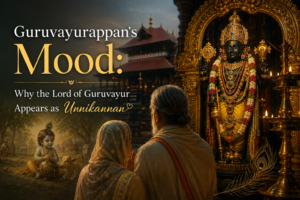
Every person who goes to Guruvayur and stands in front of the deity feels something the presence of a child. The deity does not feel like a king who is far away but like a little kid who looks back at you. This little kid has the innocence and playfulness as Krishna when he was, in Vrindavan. This is not just because of how the deity’s shown. It is actually what makes Guruvayurappan who Guruvayurappan is.
The Form and the Feeling Are Not the Thing
If you look closely at the deity what actually stands there is Mahavishnu. Four-armed, holding the shankha (conch) chakra (discus) gada (mace) and padma (lotus). This is the form of the Supreme Lord in His cosmic aspect. It is the form worshipped by sages like Poonthanam and by devoted souls like Kururamma.
Yet everyone who comes for darshan does not see a four-armed Vishnu. They see Unnikannan. The Krishna. Ask any visitor to Guruvayur what they feel when they stand before the deity and very few will describe awe before a cosmic emperor. Almost all will describe tenderness as if greeting a child.
How can the same form give two different experiences?
A Deity Standing in Viraha. Separation from Vrindavan
This is the key to understanding the mood of Guruvayurappan. The deity was consecrated in. Continues to carry the *bhava* in which it was originally worshipped. The bhava of Devaki and Vasudeva.. That bhava is one of separation of *viraha* from Vrindavan.
In words the Krishna who stands at Guruvayur is not in mood the boisterous butter-thief of Vrindavan surrounded by gopis and cows. He is Krishna as felt by parents who never had Him close during His childhood. A Krishna who’s emotionally *away from Vrindavan*.
This is why devotees often describe an aching sweetness in Guruvayurappans darshan. A tenderness mixed with longing as though the Lord Himself is somewhere between two worlds: present before you and yet also remembering or being remembered from a Vrindavan He is separated from.
The Bhava of Devaki and Vasudeva
The deity now worshipped at Guruvayur was, according to tradition worshipped ago by Devaki and Vasudeva. Krishnas own parents.. Notice something important: they did not worship it as “the idol of the Supreme Lord, Narayana.” They worshipped it as “my son.” Their bhava was love, not cosmic reverence.
There is something significant still. Devaki and Vasudeva never witnessed the leelas. The playful pastimes. That unfolded in Vrindavan. They never saw baby Krishna toddling after a pot of butter never watched Him steal curd from the gopis pots never saw the dancing child that Yashoda and Nanda raised. That entire world of Vrindavan leelas belongs to Krishnas parents, not His birth parents.
Devaki and Vasudevas worship then carried a particular emotional colour: the love of parents who bore their child sent him away for safety and never got to experience the joy of raising him themselves. Their bhava was not one of intimacy but of tender longing.
Darshan Follows Bhava, Not Just Form
The answer lies in a simple but profound truth: the Lord reveals Himself according to the bhava. The emotional disposition. Of the devotee. This is a promise the Lord Himself makes again and again: In whatever form you wish to see Me in that form I shall come to you.
The form on the altar remains constant. Vishnu with His four hands and divine weapons.. The experience of that form is shaped by the heart of the one who worships.. This is precisely what happened at the very origin of this deity.
Why This Understanding Matters
Knowing this changes the way one can approach Guruvayurappan. It is not enough to think of Him as a majestic four-armed Vishnu to whom prayers of grandeur are offered, nor only as a joyful playful child to be indulged the way Yashoda indulged Krishna. The mood true to this particular deity is the mood of Devaki. A parents love shadowed by absence a devotion that says: *”I could not raise you myself but my heart never left you.”*
When a devotee approaches with this understanding. With the tenderness of longing than mere ritual formality. Something shifts in the quality of connection. The Lord all responds to the bhava He is offered.. Guruvayurappan, standing eternally in the mood of separation, from Vrindavan is perhaps waiting most of all for hearts that can meet Him in that very feeling: love that aches with distance and yet never stops reaching out.
This reflection draws on the understanding of Guruvayurappans origin through Devaki and Vasudeva and the teaching that the Lords darshan is shaped by the bhava of the devotee.