
OUR STORY OF DEVOTION
A history five thousand years in the making and a new chapter now being written at Brahmakulam.
OUR STORY OF DEVOTION
A devotional truth that has always lived quietly within Guruvayur itself and a temple built to finally bring it into the light.
The Path to This Temple
The devotional truths that shaped this temple’s vision. From ancient legacy to a temple being built today.
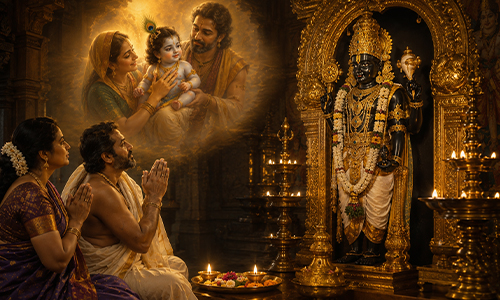
The Hidden Krishna Bhava of Guruvayur
Though the Guruvayur deity holds the symbols of Vishnu, it was worshipped by Devaki and Vasudeva as their own son. A deity carries the emotion of how it is worshipped so within that form lives the intimate mood of Krishna
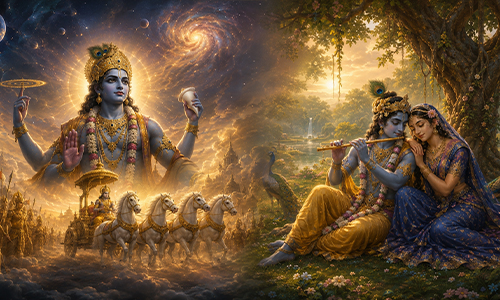
Every Divine Person Has Two Lives
God’s official life governs all creation, vast and without limit. But even the Supreme has a personal life of ease and intimacy. For Krishna, that place is Vrindavan where Radha is dearest to Him.
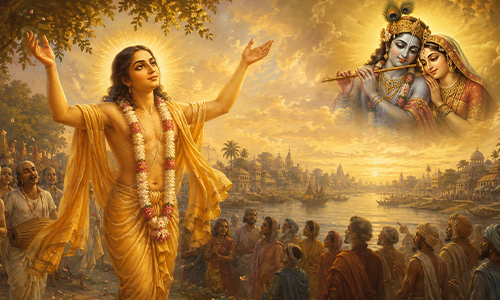
A Truth Revealed by Sri Chaitanya Mahaprabhu
Gurudev’s lineage worships Radha-Krishna as the highest devotion, tracing to Sri Chaitanya Mahaprabhu, who appeared in Bengal 500 years ago as Krishna in Radha’s mood. He revealed her glory and instructed that this teaching reach every town and village.
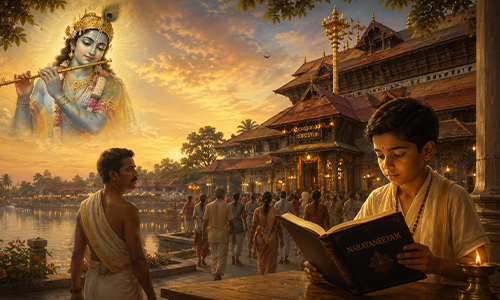
Answering a Call: Why Guruvayur
Guruvayur holds a special place in Malayalis’ hearts, where Krishna is beloved. For Gurudev, a Malayali, the path unfolded naturally. As a child, his father had him read only the Narayaneeyam alone.
Why Radharani Belongs at Guruvayur
If the Guruvayur deity carries Krishna’s emotions, it naturally carries His love for Radha too
a devotional truth that has always lived quietly here, waiting to be completed. Two truths, taken together, tell the whole story:
completes the devotion
About Gurudev A Life Shaped by Devotion
Acharya Padatirtha Bhakti Swarupshan Swami, known to devotees as Gurudev, was born in Kollam, Kerala, and raised in Pune, where he trained as a Computer Science Engineer. He built a promising career with a leading American IT firm before leaving it behind at the age of 21 to dedicate his life to Krishna consciousness. He spent four years in formal scriptural training at ISKCON Chowpatty, Mumbai, and was initiated by His Holiness Jayapataka Swami Maharaj, a direct disciple of Srila Prabhupada, before returning to Kerala at 26 to begin the work that would eventually lead here.
Gurudev speaks of his path to Guruvayur not as something planned, but as a journey that revealed itself one step at a time shaped less by ambition than by a lineage, a longing, and a quiet sense of purpose he carried long before the temple was ever imagined.
A Living Lineage
Just as one learns a profession from those who mastered it before, spiritual life passes through a living lineage. Gurudev's tradition holds Krishna worshipped together with Radha as the highest, most complete form of devotion.
Finding Purpose
A period of real pressure and tension in his own life was eased through this spiritual path, giving him not just comfort, but direction beyond any single career.
A Life Leading Here
A natural pull back to Kerala, to Guruvayur. Even as a child, the only Malayalam text he was made to read daily was the Narayaneeyam, Guruvayurappan's own scripture.
Carrying the Mission
Not personal ambition, but one small link in a far older chain of devotion, continuing Chaitanya Mahaprabhu's own call to spread this teaching everywhere.